Party Science
Monday, April 14, 2025

Party Science
Roger Pielke, Jr., writes for The American Enterprise, that in a society like ours,
All of us are mostly ignorant most of the time, and [political scientist E. E.] Schattschneider explained that has consequences for democracy and governance: “There is no escape from the problem of ignorance, because nobody knows enough to run the government.” That means there are no philosopher kings or omniscient dictators out there. Governing well requires collaboration among people with different types of expertise and different political views.
As with everything else in this day and age, all signs point to expertise—not merely academic credentials—having been captured by political tribalism.
I’m sure we’ve all seen it before: the evidence that Science! is firmly in the camp of progressivism, with Truth! on one party’s side. Some of us who don’t agree with the political aims of the ideologues, though, find lots of weaknesses in the proclaimed and implied certitudes. For instance, that they may also succumb to the all-too-human tendency simply to dismiss ideas that would undermine their politics.
As it happens, the survey data that Pielke presents could just as strongly indicate partisan-ideological confirmation bias. That is, politically partisan experts seek out and find exactly the proof to justify conclusions they set out to find initially. The conclusions are on the left because the overwhelming political inclination in academe is toward the left. This accounts for the finding that the strongest, most resilient confidence in academic expertise is among highly educated, affluent, liberal whites.
It would be interesting if causality could be teased apart: did high levels of educational attainment cause political identity? Or did political affinity help a subset of individuals perform better in classes on the way to higher degrees?
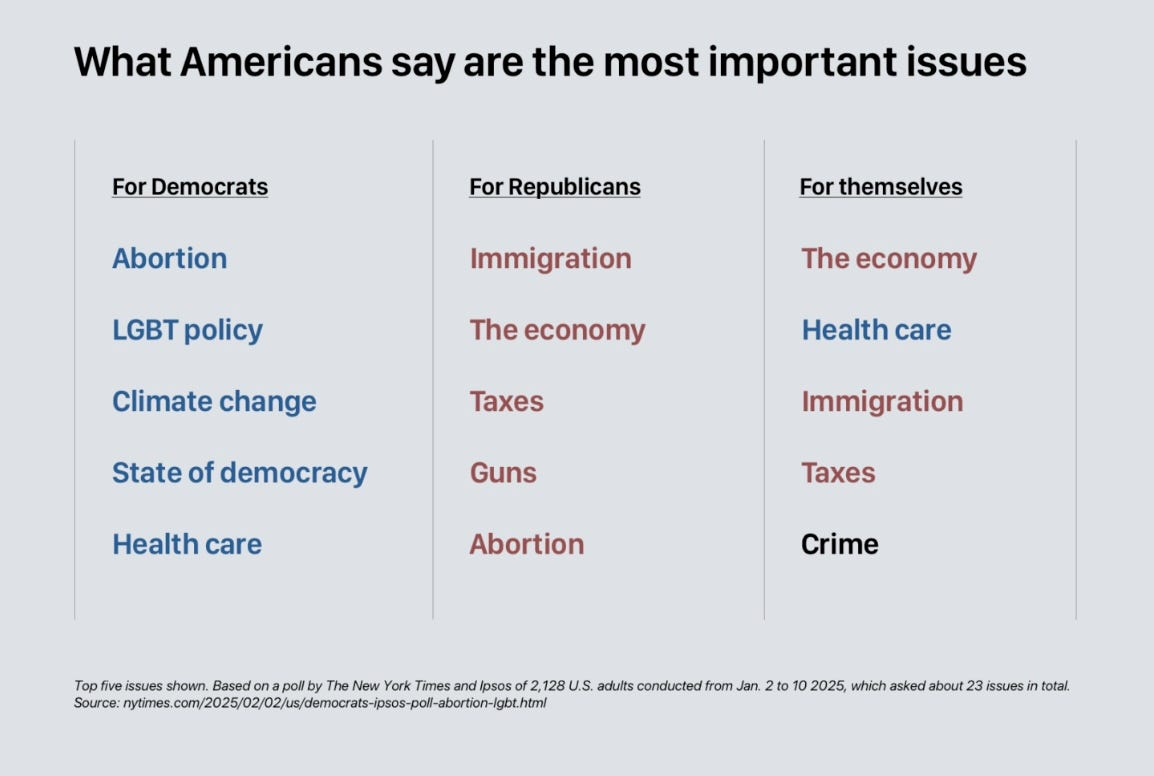
The issues that experts in universities find pertinent appear to be closer to what the citizenry attribute to one party’s agenda. What survey respondents believe is important for themselves mostly diverges from that issue set. This leads voters to feel higher education is hard at work against voters’ and taxpayers’ interests. Pielke presents this short chart based on the survey as evidence:
The challenge lies in keeping expertise viable for everyone. Not that research has to change its biases, but that it should not be used to promote a specific agenda. Continuing to do so only further alienates the public that in many cases are paying for the pursuit of knowledge—through tuition and/or tax money—in the hopes of benefiting society at large.
My husband just found the rechargeable battery for the weed whacker. F was insisting it was gone forever. Took less than 5 minutes of a person actually looking for it.
The chart is very interesting. Some thoughts about the survey design: I think "the economy" and "taxes" are not really two different things. Both labels, at the level of "issues for themselves," are about your individual perception of your present prosperity and future opportunities.
"State of democracy" as an issue is nebulous, basically a vibe. My impression of "democracy" concerns is that they are largely a concern that people are voting differently from the way the person concerned about "democracy" thinks they should.
And good morning, everyone. The weathers here is 50-ish right now and expected to be 84 this afternoon. We are not doing dog-and-cat for the neighbor today, unless he texts me later with a request. Sometimes he gets held up at work, or his teenage son isn't available, and he will ask us to take the dog out at midday.