Imperfect Memories
Pining for What Never Was

Friday, May 8, 2026
The good ol’ days are mainly good because they’ve receded far enough into the past that you’ve forgotten how miserable you (probably) were back then. You’ve shed the unpleasant memories about quotidian irritations and hardships. You’ve moved beyond settling scores with those who wronged you or used to drive you up a wall. You’ve let bygones be bygones.
Most of your time these days are spent irked and flummoxed by modern trends dictated by “the demographic” that remorseless marketers design the contemporary world around. All the frustrating tech! All the stupid-looking (and -sounding) trends and fashions that fail to please you aesthetically! The coddled younger generation consisting of the clueless and rude! They have no appreciation for how glorious the past was, when the weather was always warm, sunny, and welcoming; when people, institutions, structures, and machinery all hummed along with joy and non-malfunctioning perfection. Everything worked better. The people were better. We used to greet one another with a smile on our lips and a song in our hearts.
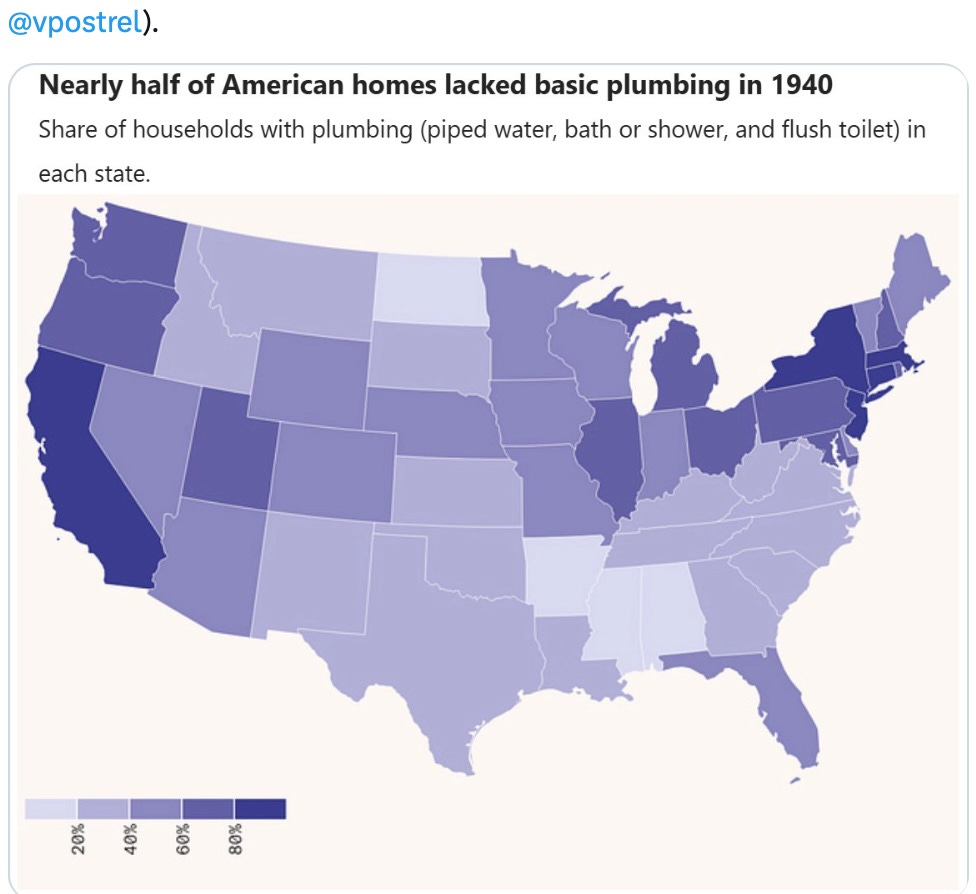
What wonderful lies we like to tell ourselves. In truth, the best part about the past is that it’s irretrievably gone, and we’re no longer stuck in it. If you had been this full of crap back then, for instance, you probably would have had to go outdoors to relieve yourself:
In this vein, Megan McArdle posted an audio essay politely reminding us that even the nostalgia just ain’t what it used to be.
Here’s an excerpt from the YouTube transcript (line-by-line timestamps omitted):
[3:50] Another issue is just that when you look at [classic] movies [from the 1950s], when you look at the images, when you go back and look at the vintage ads, there is in fact a lot of relative poverty compared to people today. But once you get above a certain income level, relative poverty is harder to see.
Look, if I show you a picture of someone living in a developing world country in a one room hut in which their bathroom is, you know, 80 ft behind the house, you see that you are seeing poverty. When you see the the poverty of 1950, which was really quite poor compared to now, people who considered themselves middle class were living worse in many ways than poor people are today, but in ways that don’t necessarily come across, especially in a picture. So, one big example is just air conditioning.
And in fact, uh, funnily enough, as late as, uh, the late 1950s, the pool makers of America were convinced that every home was going to have a swimming pool in the United States. Well, why? Because if you don’t have air conditioning and you live in a hot place, the ability to just douse yourself in water in the summer is a really valuable thing.
Here’s another example. It’s a 1956 Ford commercial. This was part of a series that that Ford ran trying to convince people to buy a second car for the household.
McArdle approaches the case with a bit more nuance, pointing to some reasons that the nostalgia isn’t all misguided. It includes some high quality vintage kitchen stoves that may have been the best ever. It reflects how a more homogeneous culture might have felt more genuinely content with itself than today’s mixture of radically divergent tastes in attitudes and lifestyles.
Her presentation is probably a bit gentler and more nuanced than mine.
Did I overstate the case? Why shouldn’t I? Is anyone really passionate for rhetorical questions?
Substack includes a variety of accounts that promote aesthetic nostalgia. "Everything was so pretty in the past!" I sometimes reply to them with, "You have died of dysentery."
"Is anyone really passionate for rhetorical questions?"
Don't you mean "passionate about rhetorical questions"? What happened to "about"?
We used to say "speak about." "The president will speak about the war." Now, it will be either "speak to" or "speak on."
We used to say "excited about." "I am excited about the upcoming zombie apocalypse." Now we say - or rather, they say, those people whose use of prepositions in English is as upwhacked as my use of prepositions in Spanish - "excited for." "Are you excited for the party this weekend?"
I am not the only crank on this subject. Allison Moorer wrote about the loss of "about" last weekend in her newsletter.
https://www.youtube.com/watch?v=dv9nOwBLy4M&list=RDdv9nOwBLy4M&start_radio=1