Worse and Worst Governance
Thursday, August 21, 2025

Worse and Worst Governance
Politics in Westernized democracies has never felt as uncertain and unstable as it does now. End of story.
Or not.
In every country, political players and interest groups go at each other hammer and tongs, in an all-out battle of everyone over everything, day-in, day-out. Those in authority have lost control of the narrative long ago to the ones who scream for attention around the clock. Those who report on what’s happening have lost the authority to report any of it in a way that holds our attention. Our society seems to suffer from nation-state-level ADHD.
Citizens are disgruntled, frustrated, fearful, and hardly know which way to run. There’s a persistent sense of immanent collapse, and we’d all best get out of the way. Things are breaking down and falling apart faster than they can be stabilized. It doesn’t even matter what “things.”
Times may have been bad in the past, but they’ve never been as bad as this!
Meanwhile, in places like Russia and China and North Korea, there are vast empires of peace and solitude. We hear nary a peep of complaint. Clearly everyone there is in harmony with whatever the rulers say and do. The people are warmly invited to participate in agreeing with the national objectives set from on high. Proclamations are read out with great confidence and in a resonant booming voice of firm, fatherly authority.
Their societies are clearly so easy and right, whereas ours are bumbling and wrong. Their leaders can tell their people what to do, and it is done without hesitation. Our leaders can’t even figure out what to do, because there’s no agreement among the public: only disarray and confusion. We fight among ourselves, and they fight us by kicking us when we’re writhing in a heap, like a bunch of sideshow mud wrestlers in a kiddy pool.
They walk confidently from victory to victory, and we flounder stupidly from embarrassment to painful belly flop.
Now, suffice it to say that all the above is a cartoonish depiction of reality, but it isn’t too far from what our adversaries want to project. They mingle in our media to promote the sensation, to make us feel defeated, to get us used to feeling hopeless. That’s the easiest way to get us to give up: by getting us to give in. Why fight for something when all is already lost?
What it fails to take into account is that in Westernized democratic systems, dealing with disagreement is a structural feature. Disagreement is not suppressed for long, even in the best of times. The struggle to gain power is relentless, and Westernized democracies provide arenas for the struggles to take place. And there is no detail that is too trivial to be fought over.
The rivals to our systems—the autocrats—use oppression by the liberal application of force and brutality: Those are their ultimate methods. You can participate as a lowly citizen there as long as you don’t question the rulers’ authority, as long as you don’t claim or think they are wrong. Opposition is bottled up for years at a time. Opposition finds no legitimate outlet in the system, because opposition would imply the rulers are substandard, not perfect. If they aren’t perfect, they are weak. Weakness, if perceived as such by the people, is one of the greatest challenges to their rule. Thus, perceptions of weakness must be suppressed at all costs.
The quote attributed to Winston Churchill still applies: Democracy is the worst form of government, except for all others which have been tried. It is worth fighting to preserve. It shouldn’t be discarded simply because it is cacophonous and frustrating. The alternatives have even less to recommend them. Their appearance of peace and harmony is a fiction maintained at great cost to the citizenry. Because they have nothing to recommend them, they have a very serious need to tear us down.
When it works as designed, our system feels somehow broken and dilapidated, on the cusp of failure and collapse. Criticism of those in power in a democracy is ceaseless and unsparing; it is the normal state of affairs. Praise and satisfaction are scarce and hard to come by. We accentuate the negative. But then the ones in power are swept aside according to the system’s rules for elections, and the opponents have their chance to stand at the helm and have their turn facing the withering opposition.
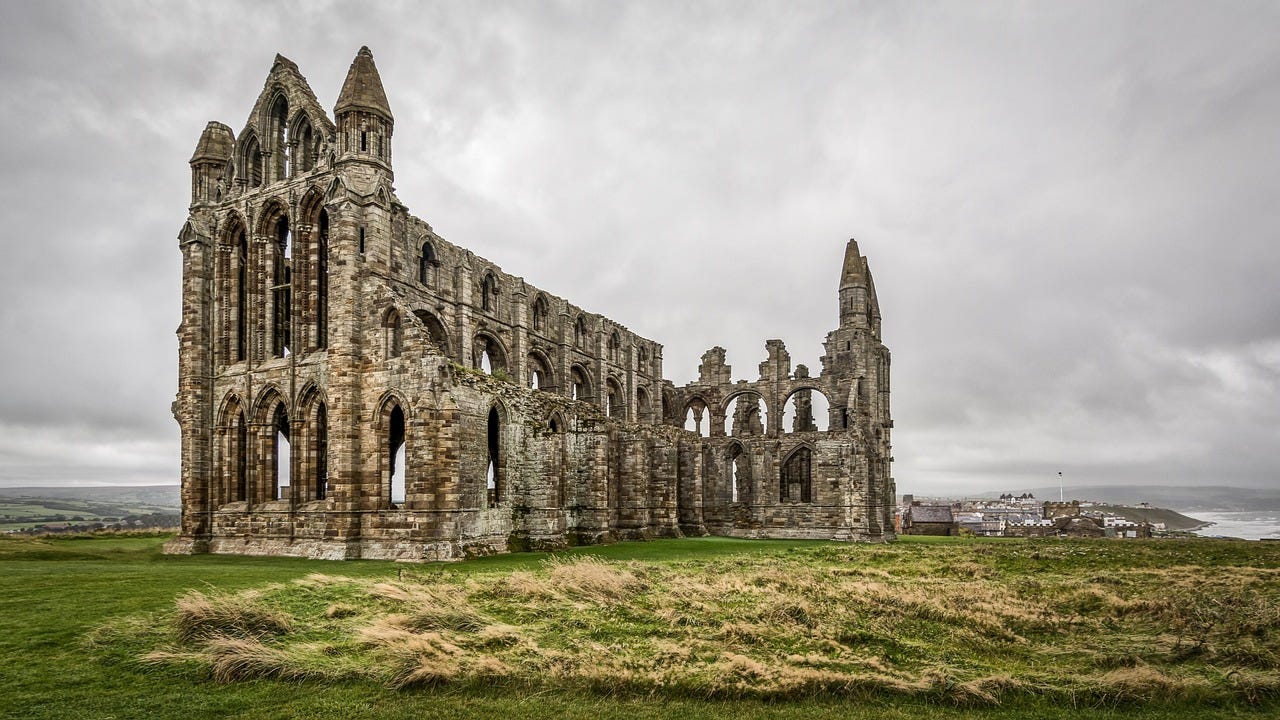
The photo isn't "collapse and decay" so much as intentional destruction by the government followed by centuries of vandalism and exposure. Monasticism in England was flourishing economically until Henry VIII "needed" to get divorced.
Absent Henry, there could have been something like the German Peasants' Revolt, which, in its local areas, destroyed many monasteries/convents.
Success! I bought my new Honda, and Drama Queen showed me enough of how it works that she thinks it's safe for me to drive it to Scouts tonight.