Going Batty
Monday, October 6, 2025

Going Batty
Today’s special animal friend is the Mariana fruit bat, Pteropus mariannus. Also known as the Mariana flying fox, it has a wingspan of about three feet and weighs about a pound. They are found in the Mariana island chain, which includes Tinian and Sarigan, as well as Guam, Okinawa, and some other Pacific islands. There are three recognized subspecies. They’re pretty cute, if you don’t think about that three-foot wingspan.
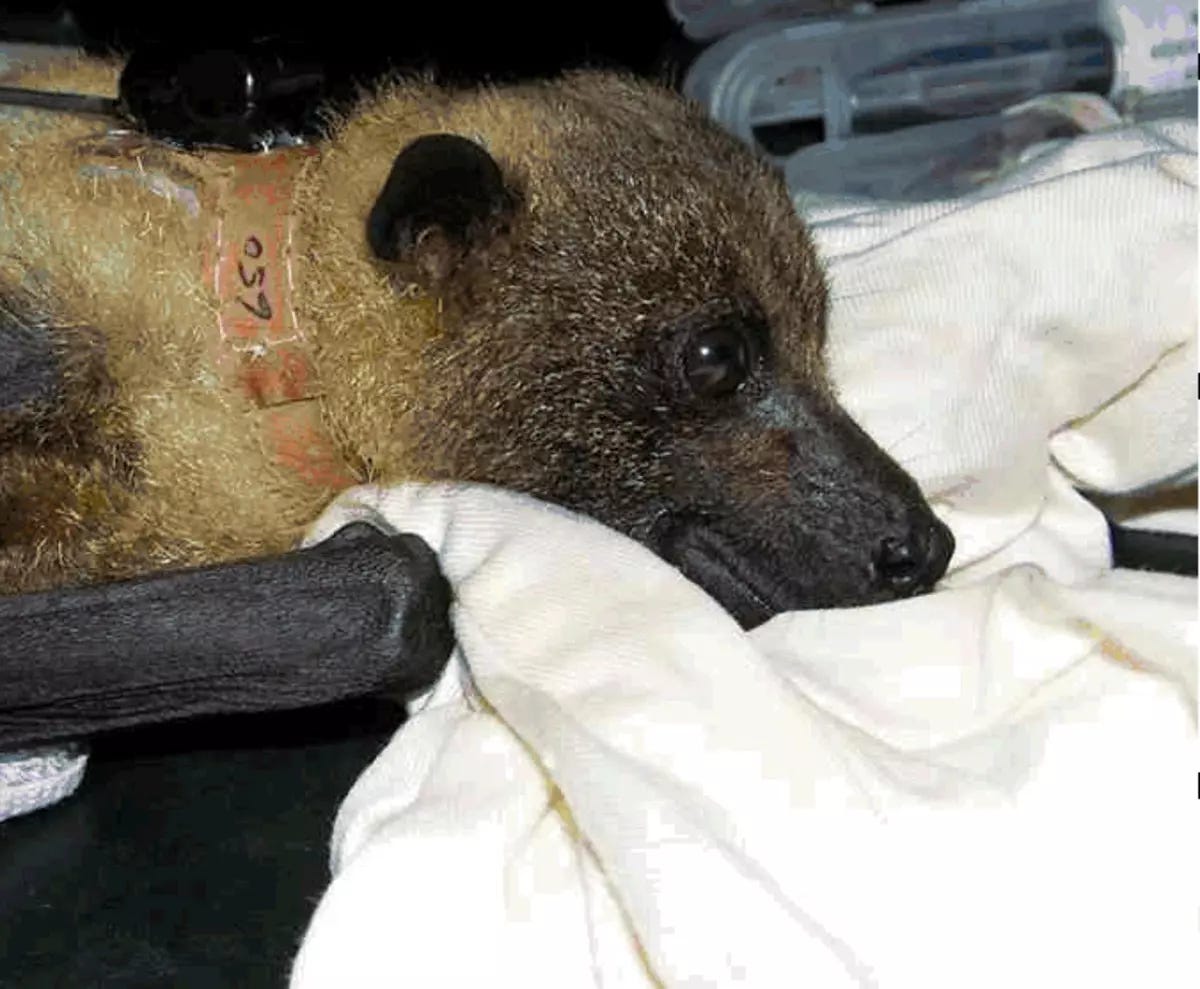
Mariana fruit bats roost in large colonies. They prefer undisturbed rainforest but will roost in coconut palm plantations if they must. Within a colony, mature males acquire harems of mature females, while adolescent males hang out in groups and play video games. Mating occurs year-round, as there is little variation in temperature through the year. Gestation is estimated to be between 4-1/2 and 6 months. Females have one baby per year, at most.
Mothers carry their babies until the babies grow too heavy, then leave them at the roost site while the mothers feed. When roosting, mothers wrap their big leathery wings around the babies. Maturity is at about 18 months. Their lifespan is not known, but other species in this genus can live up to 30 years in captivity.
Although they are somewhat active during the day — grooming, mating, bickering — Mariana fruit bats feed at night. As you would expect, fruit is a large part of their diet. Breadfruit, papayas, and figs are some of their favorites, and they often travel several miles during the night to reach trees with ripe fruit. They also eat some flowers and leaves. They are very important pollinators and seed-dispersers.
The Mariana fruit bat is Endangered, according to IUCN, and Threatened, according to the U.S. Fish and Wildlife Service, which is involved because of Guam. Timber removal and invasive animals, including cows, are destructive of their habitat. In addition, Mariana fruit bats are “an important cultural food” for the native Chamorro population. To eat bats, they will ignore the law and also risk amyotrophic lateral sclerosis-Parinsonism dementia complex, a neuropathological disease caused by toxins from cycad seeds eaten by the bats.
Cycads are a class of plants that resemble palms and ferns but are not closely related to either. They have a symbiotic relationship with some photosynthetic bacteria that help them to fix nitrogen and also produce a neurotoxin called BMAA. This toxin is concentrated in the seeds and accumulates in the flesh of the bats.
Here’s a little plug for tourism to the Marianas.
Good morning. 56 degrees here, with a predicted high in the upper 70s but more likely reaching 80, and cloudy. Rain predicted for tomorrow and Wednesday.
The mothership is reporting on the status of Syria, which has a semi-stable government under its new president and held parliamentary elections last weekend (albeit with a restricted electorate). The FP reflects on Shakespeare and Trump’s “thirst for revenge”. There is also an article on immigrants living in fear of ICE.
Irritated with the teenagers, Cynthia?