Fearing the Future
Friday, December 6, 2024

Fearing the Future
America seems to be glum about its future—at least the collective bit. Which is something to worry about, paradoxically enough. The future is something we seem collectively to live in fear of these days, rather than in hopeful optimism. Part of the fear is irrational, as I’ve been arguing: a fear that we are the cause of planet-destroying climate change just by the very act of living. But we’re also collectively afraid of not having enough health care, of people with different opinions, of insufficient government oversight—ultimately of any type of innovation in thought or action at all.
Kurt’s Monday essay—Patron of the Arts—illustrated what it might potentially feel like to live in a society where there’s a sense of optimism about the future: that change for the better is ahead because it is something we can pursue as a nation. Instead, we have erected a gargantuan state meant to protect us against everything we might do or imagine doing. We built it essentially to save us from ourselves, since we can’t be trusted.
American society at this point in time feels to me like an aging society that is more afraid of losing what it has than it is of embracing new opportunity. It feels like a society that wants a big, cushy national government to forestall any unhappy developments, and prevent them with a paternal brutality where need be. We’ve always had a federal government that was as subtle as a ton of bricks. Its attitude was one of: You’ll get as big as we let you—and don’t you forget it! I don’t know exactly why, but our federal government has always sounded like that to me.
There are always those who would willingly work with coercive power by kissing up. But it would be preferable to have a society that was more permissive when it comes to opportunity, and perhaps less so when it comes to, say, petit larceny or immigration lawbreaking.
Or perhaps it’s something else entirely, or else it isn’t a thing at all, since I can’t quite put my finger on what it is. Maybe it’s something missing, as if we’d thrown in the collective towel in the face of obstacles and challenges. There’s nothing we’re collectively looking forward to in terms of big inventions or discoveries. I’ve read a lot more about how innovation these days is small or insignificant as opposed to the past. In the past, we got innovations like indoor plumbing, electrification, air travel, and spaceflight within a generation. Today we get a new smartphone widget that helps you coordinate your fashion or rate your blog output.
What would ChatGPT think of this?
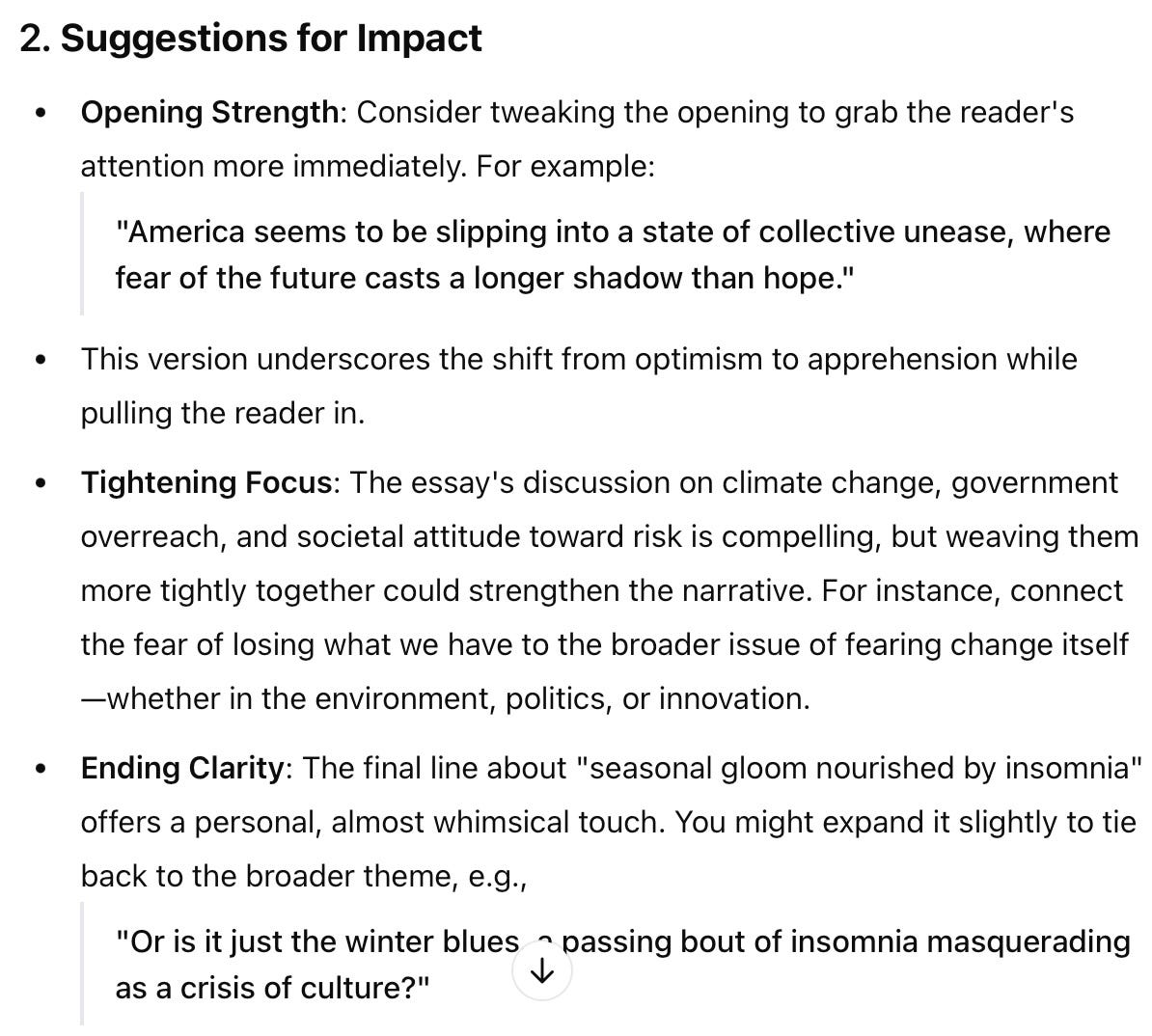
Or is it mainly just seasonal gloom informed by insomnia?

Today’s special animal friend is the lilac-breasted roller, Coracias caudatus. This sturdy, colorful bird is found throughout the lower half of Africa. They are about 10 inches high, with long tail streamers, and they are colored in patches of green, blue, reddish, olive, and the distinctive lilac (or purple) breast, as if you told your child to color a colorful bird while you make dinner. The two subspecies have slightly different shades. Males and females look very similar, while juveniles have more subdued coloring.
https://ebird.org/species/librol2
The members of the Coraciidae family are called “rollers” because some of the species engage in aerobatic courtship flights. Because it’s hard to tell the sexes apart, ornithologists aren’t sure whether this is a behavior of males only or of both sexes. It looks very air-show, and I thought about that crash in “The Great Waldo Pepper”.
https://www.youtube.com/watch?v=BAiROYPvxVM
They live in open, savannah habitat with some large trees and shrubs. They often perch on a branch in a clearing. They are carnivorous, consuming lots of invertebrates as well as lizards, snakes, and other birds.
https://www.youtube.com/watch?v=hbnXdJP4igE
As is so often the case with southern African animals, the breeding season depends on the local rainfall patterns. They are cavity nesters, putting some dead grass in a tree hollow or an excavation in a termite mound. They don’t dig their own hollows but take over the homes of other animals. The female usually lays 2 or 3 eggs, and both parents incubate them for 22-24 days. Fledging takes about a month.
https://www.youtube.com/watch?v=zByZrWPjjaY
The lilac-breasted roller is a species of Least Concern. There are abundant populations in many countries, and they are well represented in national parks and wildlife preserves.
Here's a darling new video about pets in medieval England:
https://www.youtube.com/watch?v=7b78z2jfglk